For the guard in the booth
Gatehouse software for HOA security guards.
Gatehouse software for HOA security guards is the screen a guard works from all shift: scan a pass and get allow or refuse with the reason, log walk-ins and plates, check the watchlist, file incidents, hand over in writing. We built ours for our own booths. It runs in a browser and is free for any community.
- Free for any community
- Phone, tablet or PC
- Used in our own booths
One shift in the booth.
An evening at a gated community’s main gate, from the handover in to the handover out. Every moment below happens on the guard’s screen.
2:55 p.m.
Taking the post
The day guard’s handover note is waiting on the screen to be read. In the guard app for iPhone and Android, now in testing, the incoming guard also acknowledges it. Be-on-the-lookout (BOLO) alerts have their own list, and an urgent one reads as an alarm.
3:40 p.m.
A contractor’s van at the arm
Where the entrance cameras read plates, the read is already on the screen, matched against resident vehicles, expected visitors and the deny list, with the full-size image to check against the van. Tap the plate for the residents it has visited before.
4:15 p.m.
A guest holds up a phone
The guard scans the pass and gets allow or refuse. A refusal says why: the code has expired, the pass has been cancelled, or no pass matches it. The guard app for iPhone and Android, now in testing, also says when a pass is outside its time window or already used. The driver’s argument is with the board’s rule, and the guard can point to it.
5:05 p.m.
A driver with no pass
The guard types the name and plate, and the watchlist check runs as they type: clear to admit, caution, or do not admit, with the reason. If the check itself fails, the screen says so. It never shows clear for a name it did not check.
5:30 p.m.
A resident calls the booth
Her sister is coming at seven. The guard looks up the resident and adds the visitor with an arrival time. When the car pulls up, one tap logs the arrival. If the name or plate is on the deny list, the entry is flagged on the log and filed as an incident.
7:00 p.m.
A party at the clubhouse
The host entered the guest list once. The booth checks names off one list as cars arrive, with no call to the host for each car. Afterwards the record shows who came and who never did.
9:20 p.m.
Something goes wrong
A car clips the gate arm and drives off. The guard files an incident: what, where, when, whether the police were called, with photos, video or a PDF attached. A deny-list match is filed as an incident on its own, without anyone typing it up.
10:55 p.m.
The handover out
The on-site list shows who is still inside, with host, time in and plate, and flags anyone there more than a day. The guard writes the handover for whoever comes next.
The guard’s screen.
From the guard app for iPhone, now in testing. The names, plates and community are a demonstration.
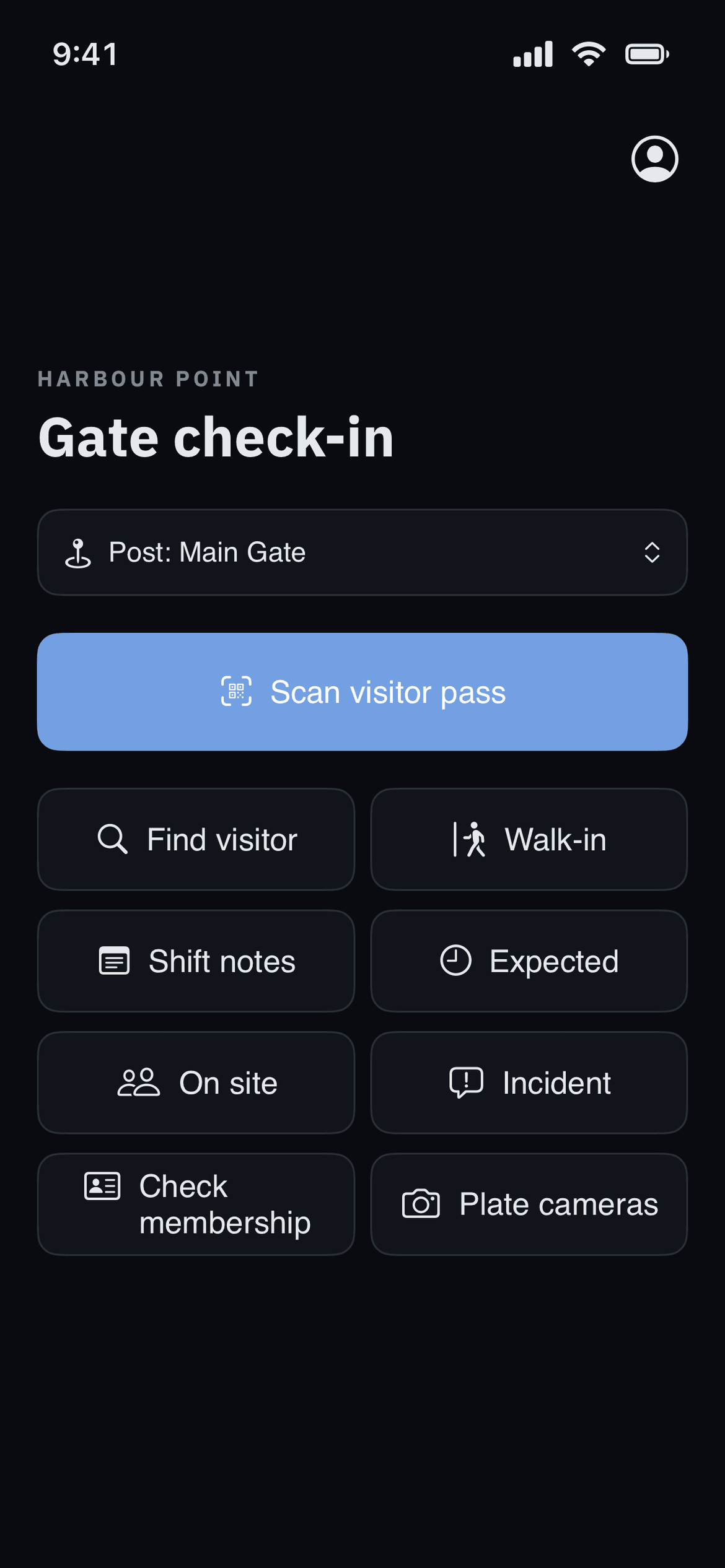
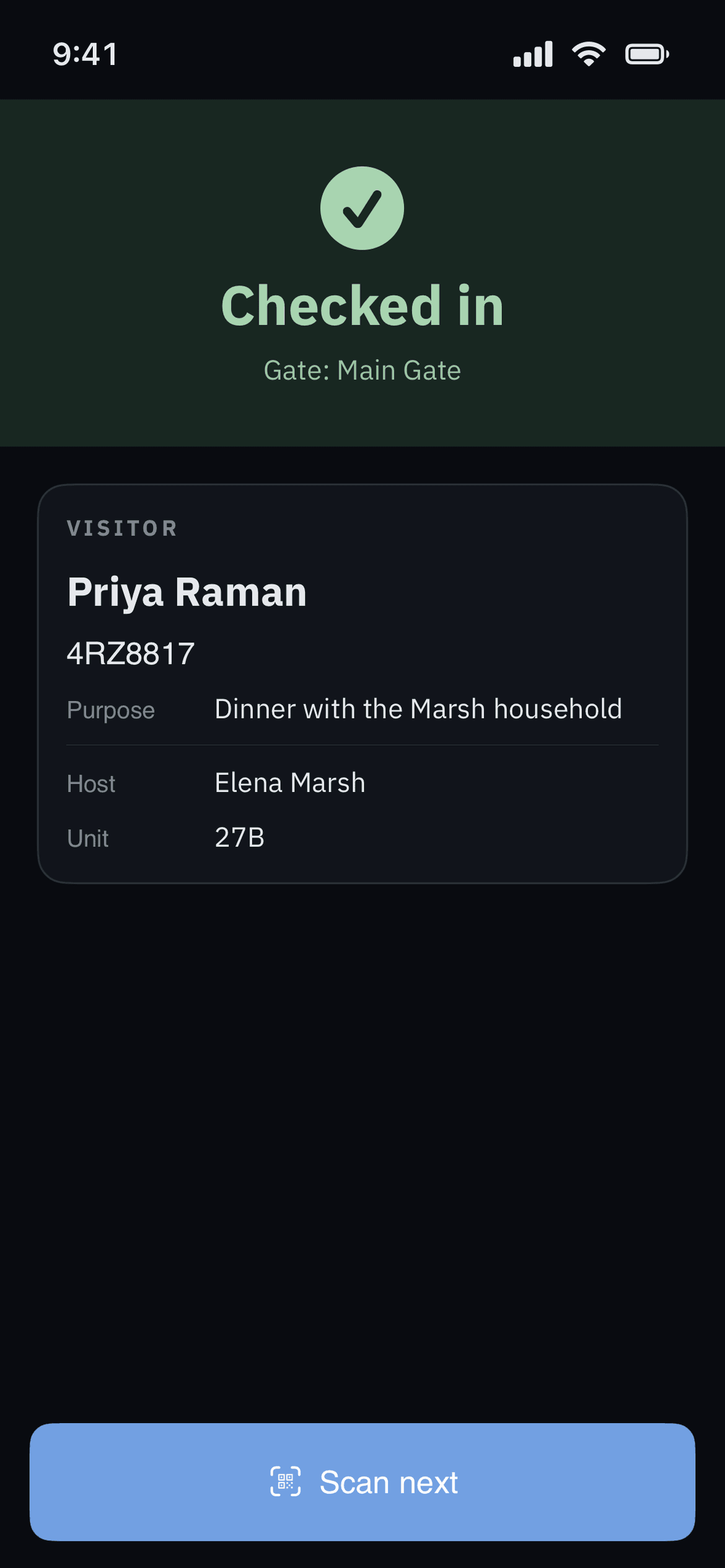
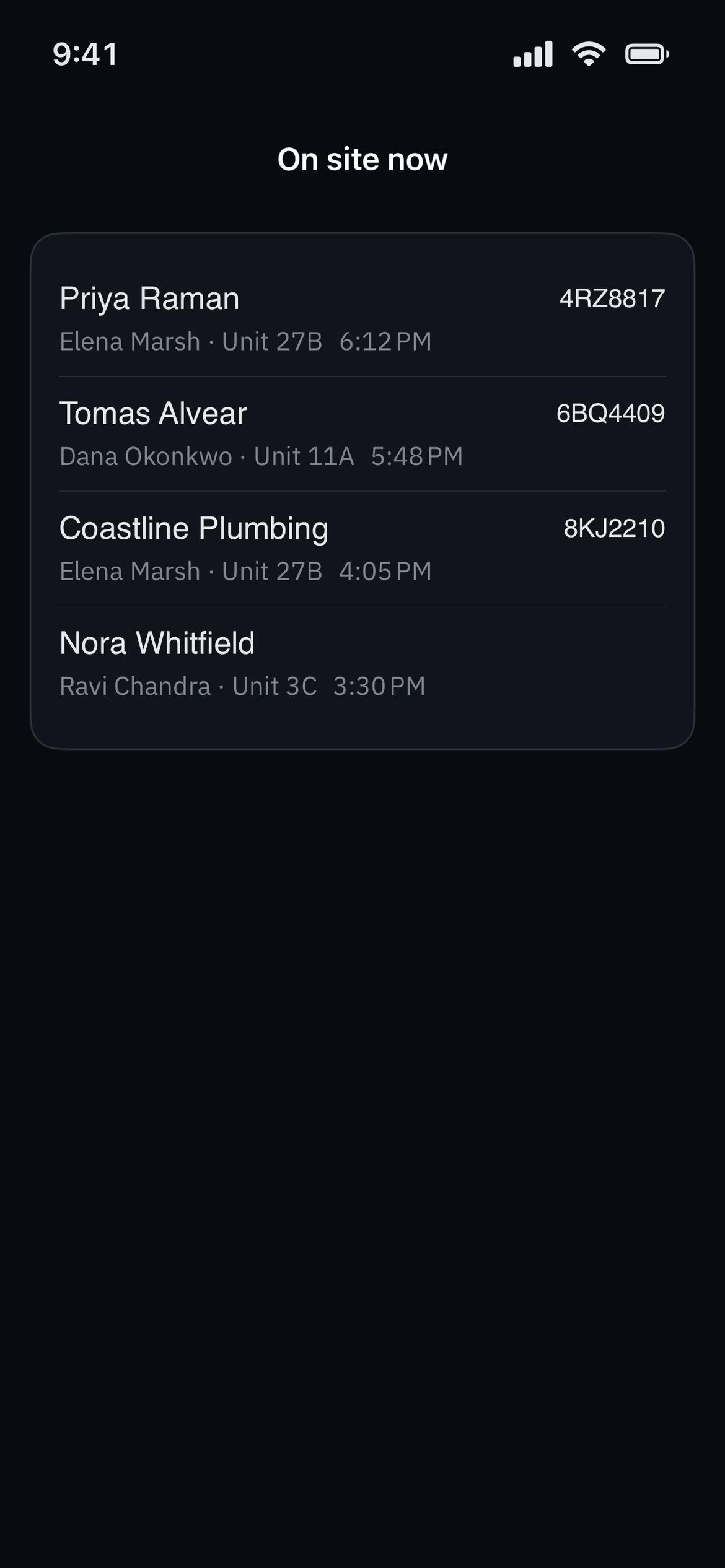
Built so the guard is not guessing.
The small rules that decide whether a bad entry gets through.
A misread plate gets a second look
When the camera misreads a plate, the guard corrects it and the whole match runs again: residents, expected visitors, the deny list, deny entries on the watchlist and BOLO alerts. The camera’s original read is kept.
The state goes with the plate
A camera reads the characters, not the state. When a resident or the guard puts a visitor on the expected list, the plate’s state goes with it, because NY ABC1234 and NJ ABC1234 are two different cars.
A licence scan that keeps the name
In the guard app for iPhone and Android, now in testing, the guard can scan a walk-in’s driver’s licence. The name is kept. Everything else is discarded on the phone.
Post orders you can show were read
An order can cover one gate or the whole community. In the guard app for iPhone and Android, now in testing, each guard acknowledges it, and an edit sends it back to every guard. The manager sees who has acknowledged the current version and who has not.
Membership cards checked against the server
Where a community has membership ID cards, part of the access control work quoted per site, the photo the guard compares comes from the server, not from the phone held up at the window.
Membership ID cards come with the access control work, quoted per site. How access control works with the platform
What it runs on, and what it cannot do.
It runs in a browser on whatever the booth has: a phone, a tablet or the booth PC, with nothing to install. Native apps for iPhone and Android are in testing.
The honest part: passes are checked against the live list, so a booth with no connection cannot verify one. Every guard has a written outage procedure, we test the connection at each gate during the site walk, and entries a guard takes on paper while offline are added to the log once the booth is back online.
For the guard company’s office.
Security companies in our partner program get one portal above all their communities. The booth sees one site. The office sees every site.
Guards and postings
Add guard accounts and assign each guard to the communities you cover. A guard sees only the communities they are posted to.
“Don’t let my cleaner in”
A resident calls the office. The dispatcher finds the pass across every site and revokes it. It takes effect at the gate straight away, records who asked, and can be undone.
Sign a visitor out
When a resident calls to end a guest’s stay, the office signs the visitor out, as the guard at the gate would.
When the booth is ours.
Max Security USA staffs booths with its own licensed security guards or security company partners in New York, New Jersey, Florida, Georgia, Arizona and Maryland, and they work from this screen. Every booth we operate ourselves is on camera inside and out, around the clock, watched from our monitoring center.
Where the gate goes quiet after dark, a licensed security guard at the center can take those hours from the same records.
FAQ
Questions about software for the gatehouse.
Put it in your booth.
Fifteen minutes on the phone covers your gates, who staffs the booth and how a guest gets in today. The software is free, whoever guards the gate.