For HOA boards and directors
A board should be able to answer the question at the meeting.
Somebody asks who came through the gate last Tuesday, or why one landscaper was turned away and the other waved in. If it wasn’t written down, the answer comes from memory and the argument runs for weeks.Our visitor platform is free for any community, with no subscription and no per-resident fee. Max Security USA puts guards in gate booths for a living, and we wrote the software because it makes those shifts easier to run.
- Platform free, no per-resident fee
- No contract, no notice period
- We set it up with you
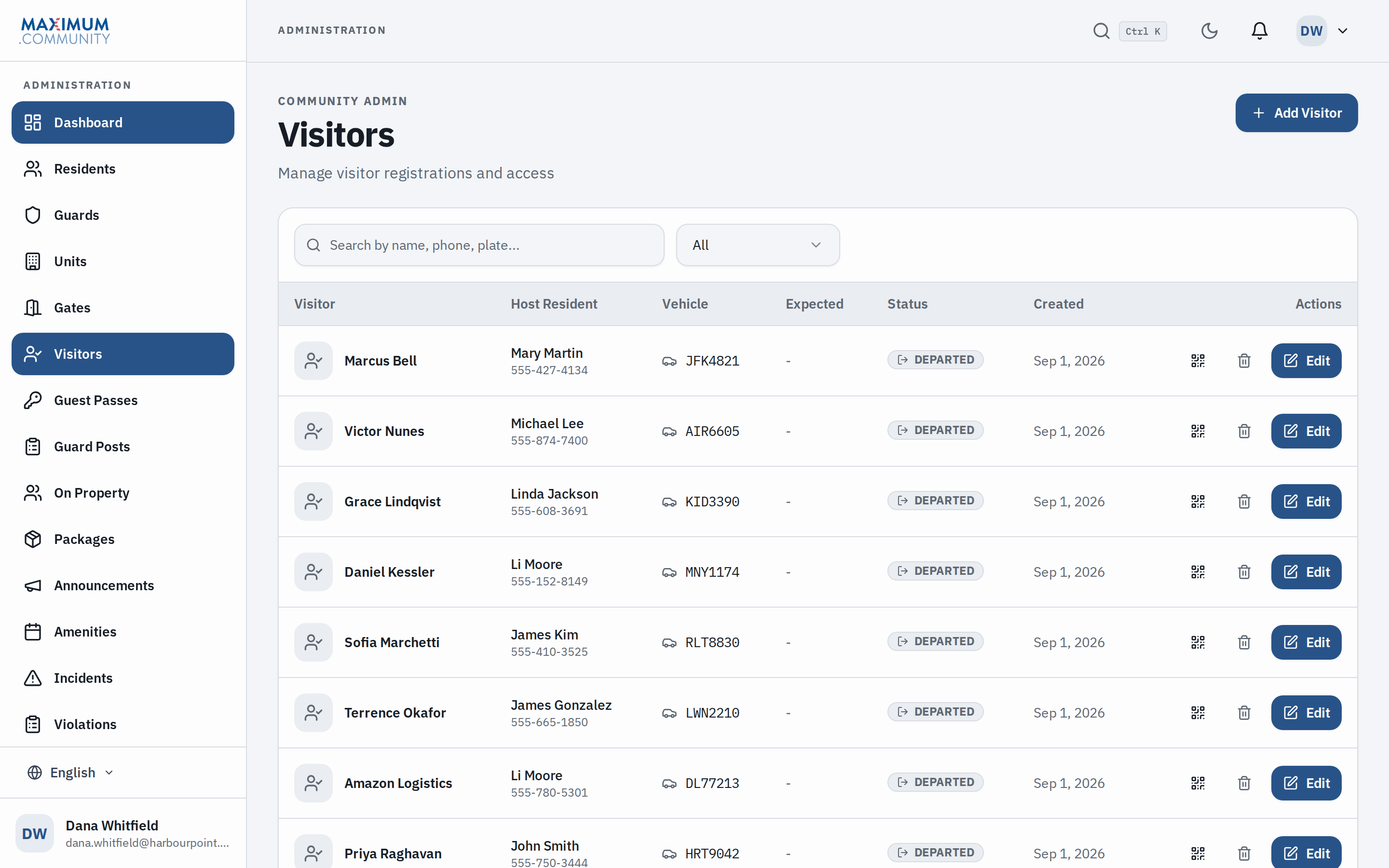
What a board carries
Five things a director carries into every meeting.
Directors are volunteers with day jobs and personal liability. Security software gets pitched to them as technology, and what they’re worried about is usually one of these five.
The budget
Every proposal that reaches a board has a number attached, and the treasurer reads that line first. On this one it’s zero. The platform is free, with no subscription and no per-resident fee.
The complaints
The call a director gets at 9pm is usually a landscaper sent away at the gate arm, or a guest stuck there while the booth phones around. Either way, nothing in the booth said who was expected.
Fairness and exposure
The complaint that costs money is the one where the rule was applied to one house and let go next door. When that lands with an attorney, what holds up is a record of who decided what, and when.
Turnover
Directors serve a term and step down. The passwords often go with them, and so do the reasons things were set up the way they were. Anything that lives in a volunteer’s inbox stops working the month they leave.
The annual meeting
Once a year somebody stands up and asks how many vehicles came through the gate, how many were turned away, and what the association is paying for. A director with the printed report answers in a minute. A director without it promises to get back to them.
What all five have in common
Each of them comes down to record-keeping. The booth needs to know who was expected, and somebody has to write down what happened. Next year, under a different board, the association still needs to have that record.
The budget answer
What this costs the association.
Anything free gets asked where the catch is. Below is everything that costs money, and why.
The platform
$0
Visitor passes, gate logs, work orders, amenity bookings, announcements, deny lists, documents and board reports, for every resident and every guard.
That’s the whole product. No starter tier, no trial.
What costs money, and why it does
Text messaging (SMS)
A real cost from the carrier, and the sending number has to be registered first. Billed only if the board switches it on. Email and in-app notifications stay free.
Access control integration
Hardware, wiring and a licensed installer to connect gates and amenity doors. Surveyed and quoted per site, and optional.
White labeling
Your association’s own branding and domain on the app, the emails and the passes. Custom work, and we quote it per community.
And separately, the guarding itself
Guards in a booth, remote guarding, vehicle patrol, camera installation and traffic enforcement are separate Max Security USA services, each quoted per site. None of them is required, and the platform is free either way.
The full list of what’s included is on the visitor management page. The paid items are itemized on pricing.
Against the clipboard
With a record, and without one.
The right-hand column is a gate with no record to check, meaning a clipboard in the booth and the memory of whoever was on shift. We’re not comparing against another vendor.
| At the gate | Maximum.Community | Without a record |
|---|---|---|
| Who came through the gate last Tuesday | A timestamped record | Answered from memory |
| The same situation at the barrier twice | One pass, one answer, whichever guard is on | Two outcomes, and no explanation on file |
| An amenity booking | The rules apply by the calendar | Depends who answers the clubhouse phone |
| When it was written down | Logged by the guard on duty, at the time | Reconstructed the week after |
| A director steps down | The successor gets the login and the association keeps the history | The passwords leave with them, and so does the reasoning |
| The annual meeting | A report the system already has | A volunteer at the kitchen table the weekend before |
Scroll the table sideways to compare →
The whole stack, from the board’s side
Start with the free items. Add the rest when a problem needs it.
A board doesn’t have to take all of it. The free items run for as long as you want them. The quoted items are for the problem that keeps coming back to your meetings, like the stop sign that gets run every morning or the overnight shift you can’t fill.
Visitor management
Residents register their guests. The guard scans the pass and gets an allow or a refuse. Every entry goes in the log with the plate, the host and the time.
Details →Work orders and amenities
Maintenance requests a resident can watch the status of, and amenity bookings that hold to the rules the board wrote.
Details →Reports and records
Entry volumes, refusals, violations, vendor activity and announcements. The system assembles them, and they export in a form you can attach to the minutes.
Details →Traffic safety and enforcement
Stop-sign and speed enforcement on the cameras you already have. A person reviews every clip before a notice goes out.
Details →Guarding, remote and on site
A guard in the booth, a remote guard working your gate from our monitoring center, or both. It’s how the overnight shift gets covered when it’s hard to fill.
Details →Vehicle patrol
Marked patrol cars and roving guards. Visible on the street, and somebody who can drive over when there’s a fight in the clubhouse lot or a car blocking a hydrant.
Details →Access control and cameras
Gate automation, entry systems and camera installation. This is hardware and a licensed installer, so we survey the site and quote it. There’s no switch to flip.
Details →Guardina, the AI gate intercom
Picks up every gate call, in whatever language the visitor speaks. A visitor with no pass or a driver who won’t give a name gets handed to a human guard, with the context already on their screen.
Details →Fairness, consistency and the record
One rule, applied the same way at every house.
An association gets into trouble when the same situation gets two different answers at the gate arm and nothing on file says why.
The platform takes the judgment call out of the booth. A pass is valid or it isn’t, and the guard can see why. Amenity rules apply by the calendar rather than by whoever picks up the clubhouse phone. A person reviews every traffic violation before any notice goes out.
A board can still be disputed. When it is, it’s holding a timestamped record rather than a director’s memory.
The same answer on every shift
A pass gets the same answer at 2pm or 2am, whichever guard is in the booth.
Written at the time
Entries, refusals, bookings and notices go in the record as they happen, not from memory the following week.
Owned by the association
The association owns the records. We hold them to run the service, access is logged, and nothing is sold.
What changes in the first 30 days
Live inside a month, in four steps.
There’s no signup button, on purpose. We verify the board and the property before anyone gets gate access, and then we do the setup with you.
Step 1: A call, then verification
Days 1–3. Fifteen minutes on the phone about how your gate handles visitors today. Then we verify the association and the property before we build anything.
Step 2: We do the configuration
Days 3–10. We enter your gates, units, guard posts, amenity rules and hours. The board looks it over before a single resident is invited.
Step 3: Guards first, then residents
Days 10–20. The booth goes live before the community does, so the guards learn the scan while traffic is light. Then invitations go out in waves, each in the resident’s own language.
Step 4: The first report
Days 20–30. By the end of the month the board has a report of entries, refusals and requests, and no director spent an evening compiling it.
What we need from the board, in full
A fifteen-minute call. Confirmation that you’re the board and this is the property. A resident roster and your current rules. One review session before residents are invited.
Nothing else. A site that needs hardware runs on the installer’s schedule, and that work is quoted separately.
No cost and no contract, and we don’t take a card.
Board turnover
Built to survive the next election.
When this fails, it’s usually because the director who understood it stepped down and the account was in their name.
Access follows the role
Accounts attach to board and management roles rather than to people. When a term ends the login goes to the next person in the seat, and there’s nothing to dig out of a personal inbox.
The history stays
Entry logs, work orders, vendor records and the rules you configured belong to the association. They outlast every director.
A walkthrough for the new director
Tell us who joined and who left. One of us sits down with the new director and walks them through it.
Managers included
Your property manager works in the same system, so changing management companies doesn’t restart the record.
The annual meeting
Questions a board can answer from a report.
The people in the room aren’t trying to catch anyone. They pay an assessment and they want to know what it buys. Whether the answer is on paper tends to decide how long the meeting runs.
The system generates the reports and they export straight into the minutes. Every figure on them comes out of your own records.
Answerable from the record
- How many vehicles and visitors entered last month, by gate.
- Which entries matched a deny list and were flagged as denied.
- Which vendors were on the property, and how often.
- How many maintenance requests came in, and how many are still open.
- How amenities were used, and whether booking rules held.
- What was announced, when, and to whom.
- How many violations were issued, reviewed and appealed.
For residents
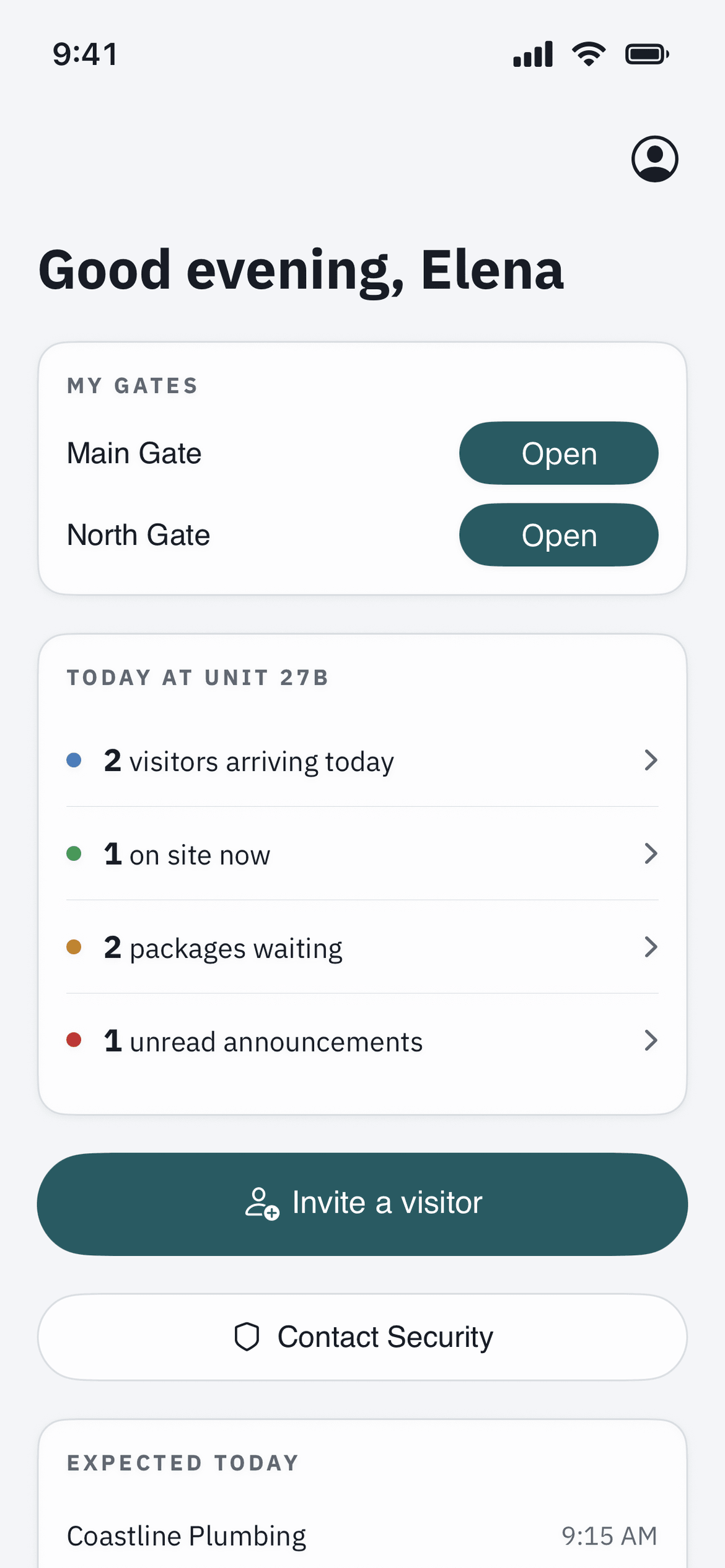
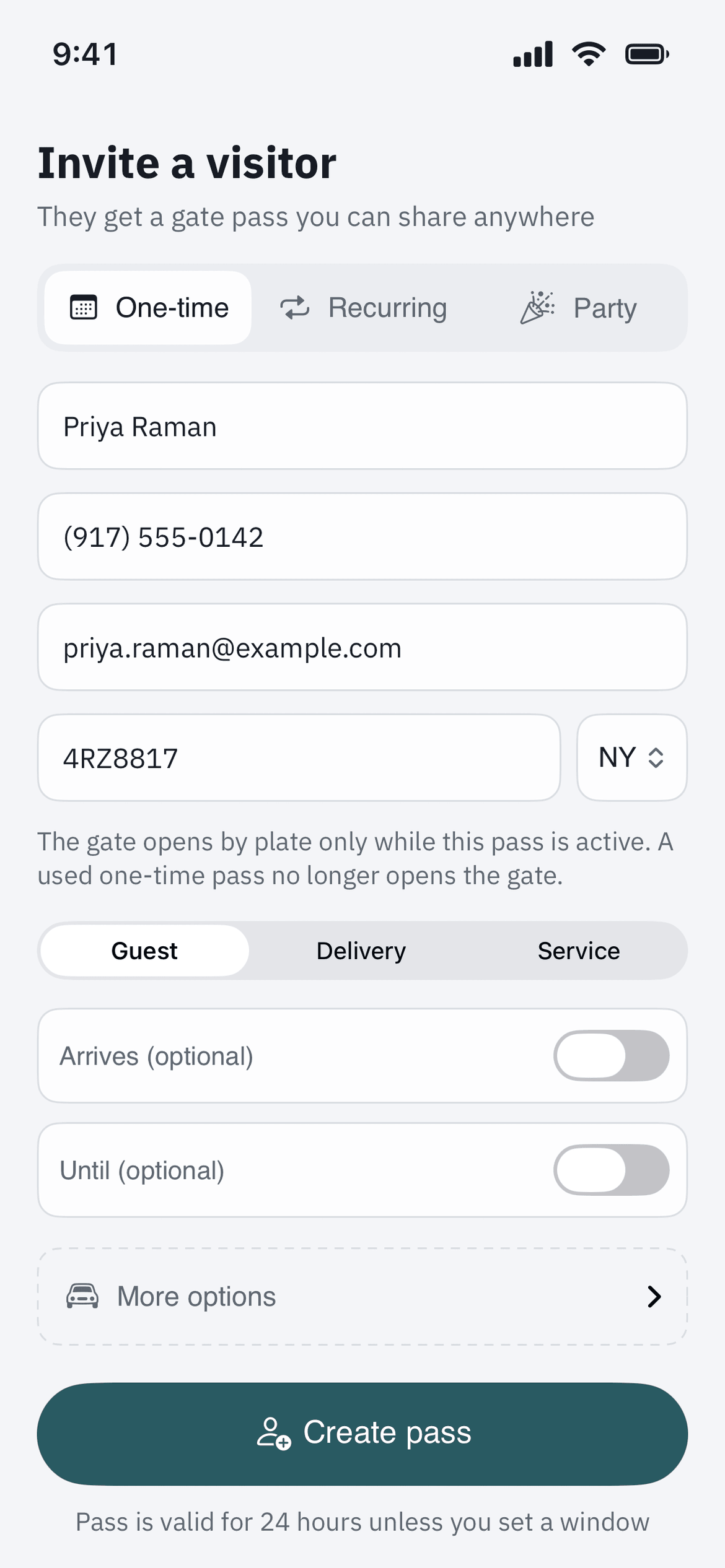
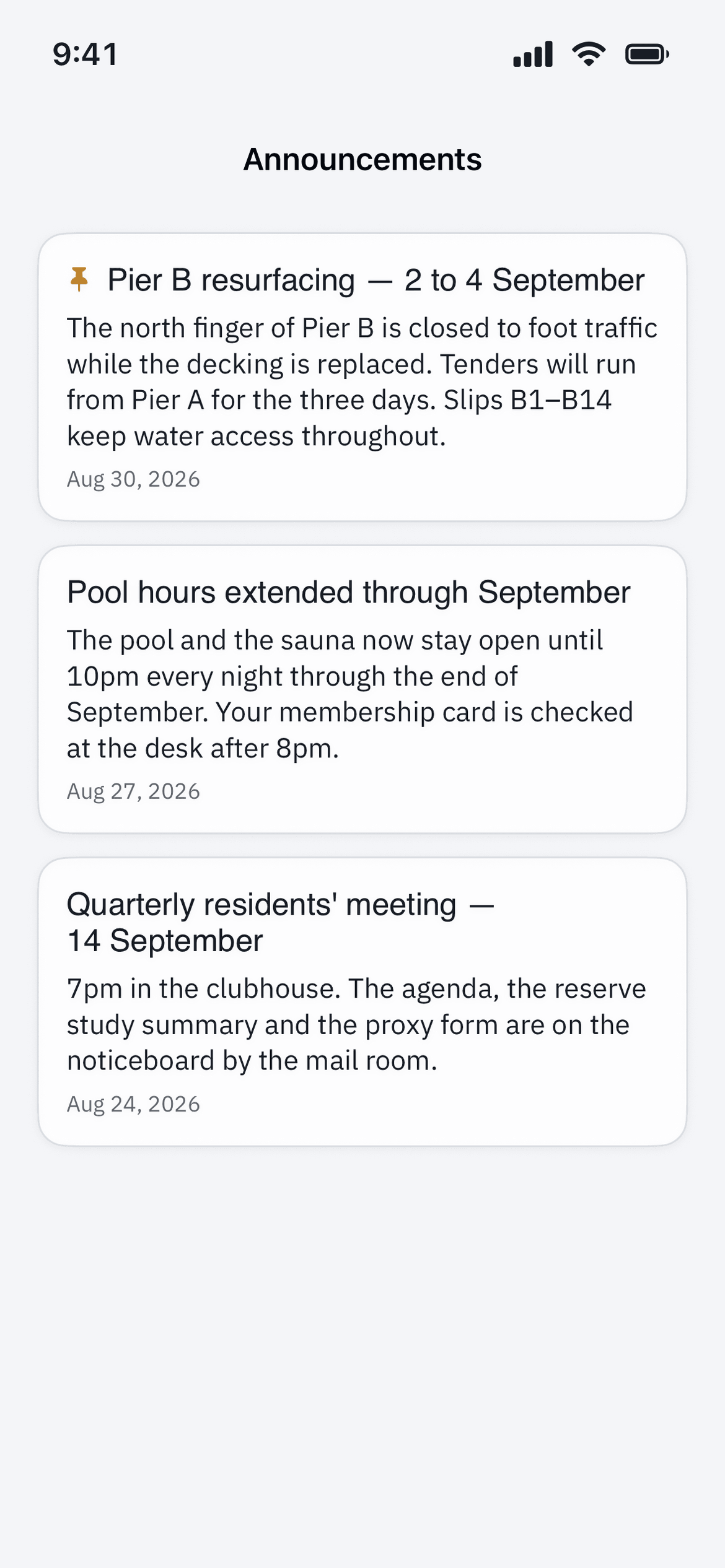
The part residents see.
The board lives in the admin console. Residents only ever see this, and if it’s awkward the board hears about it at the next meeting.
The record
What you can hand an attorney.
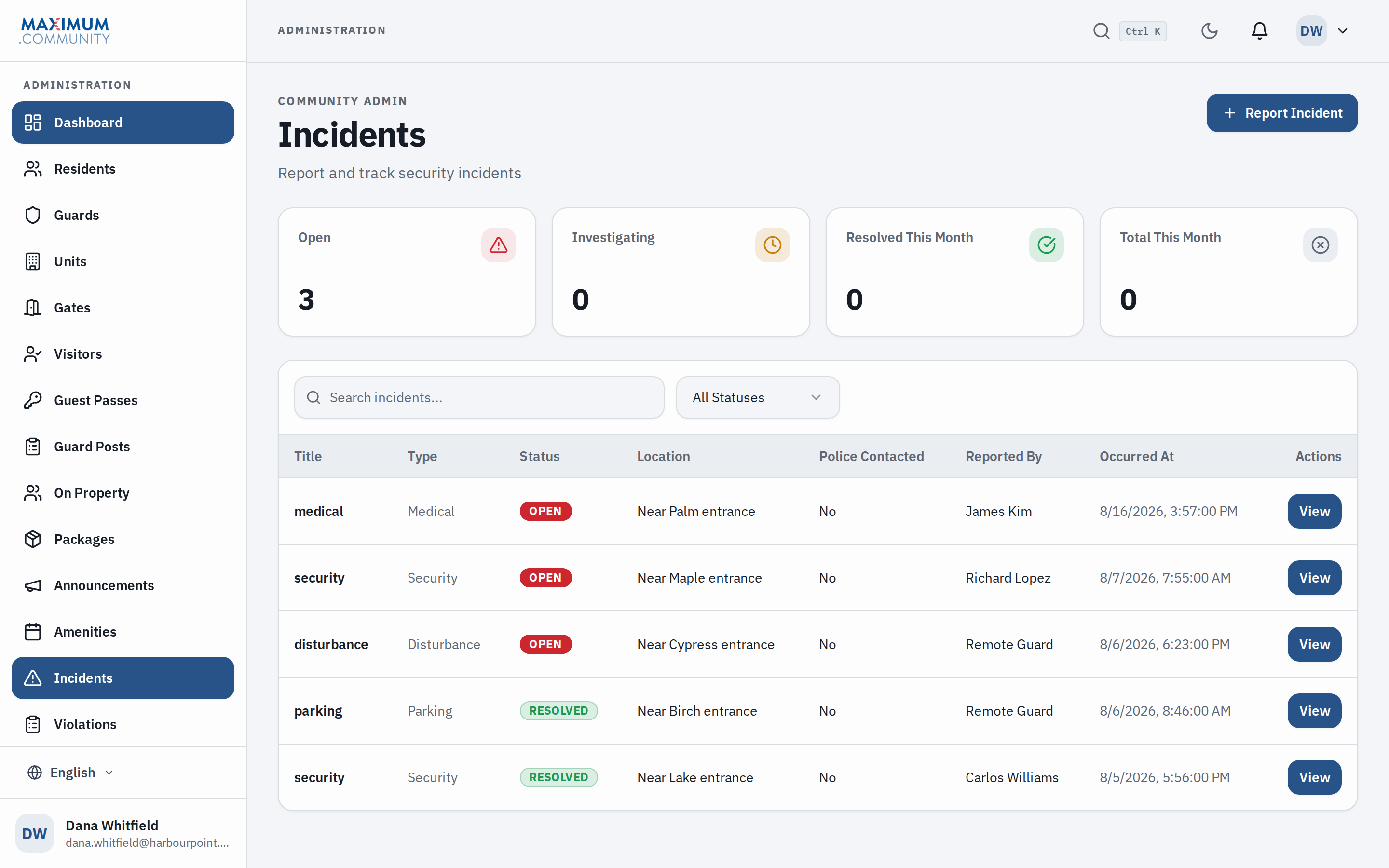
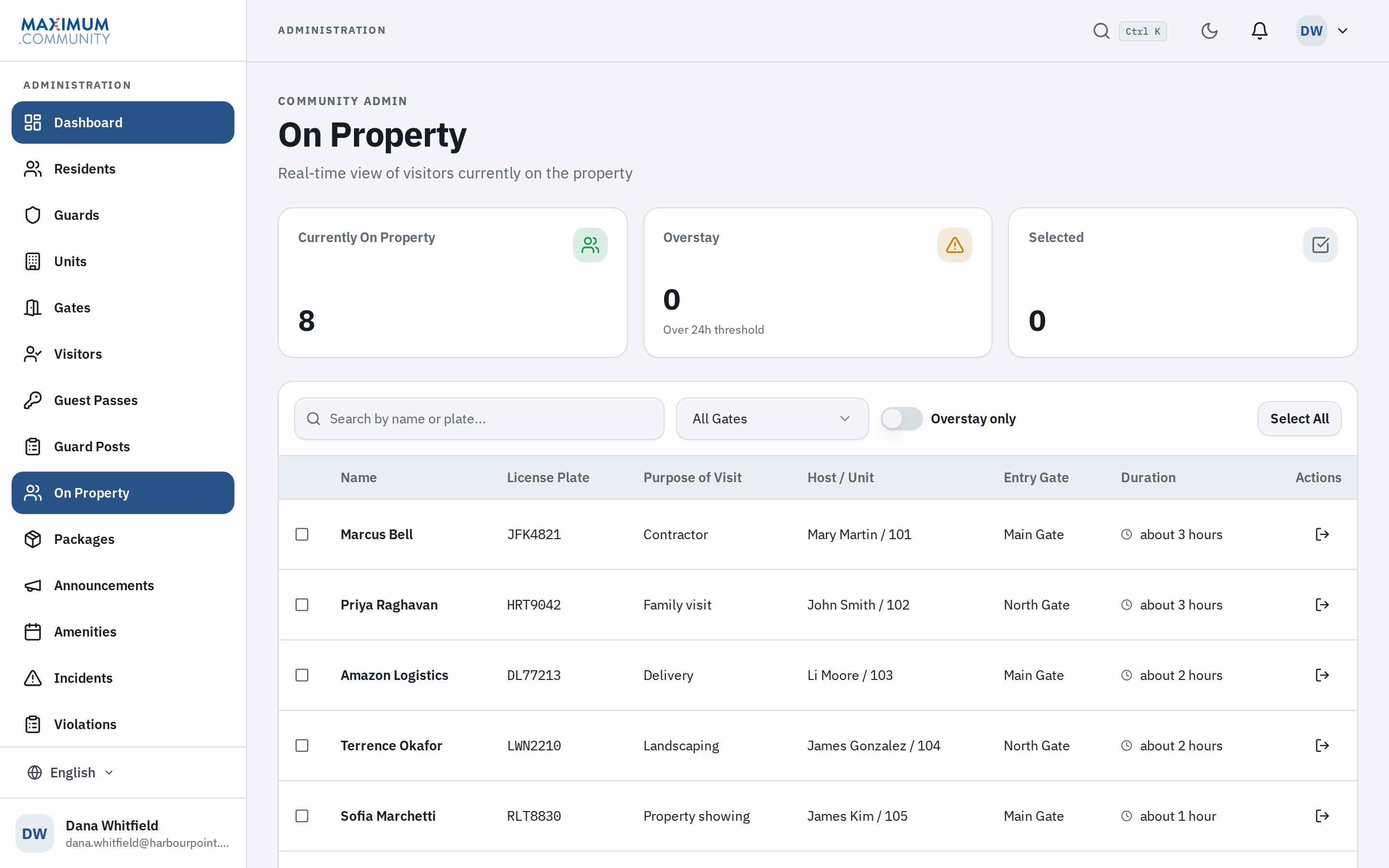
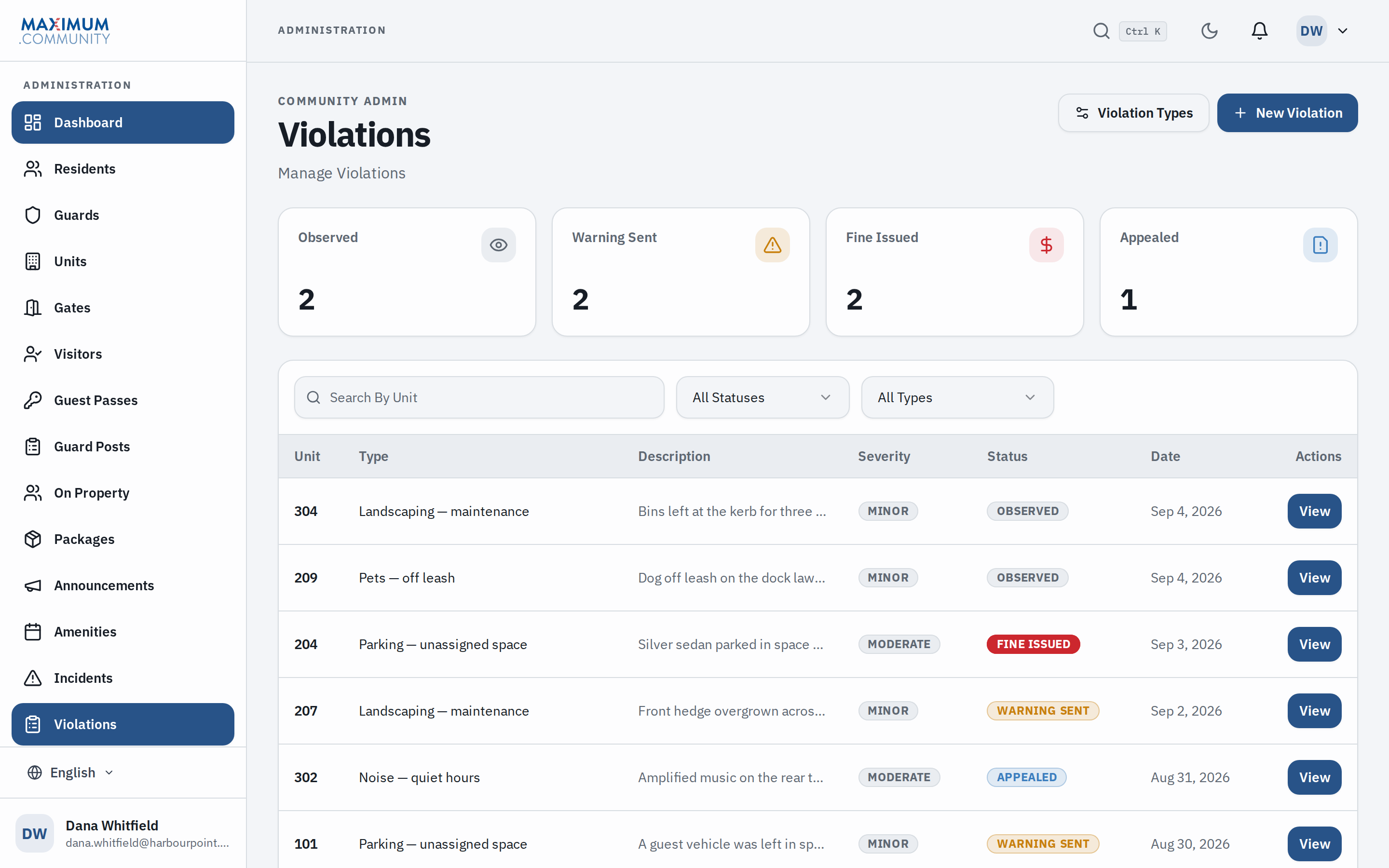
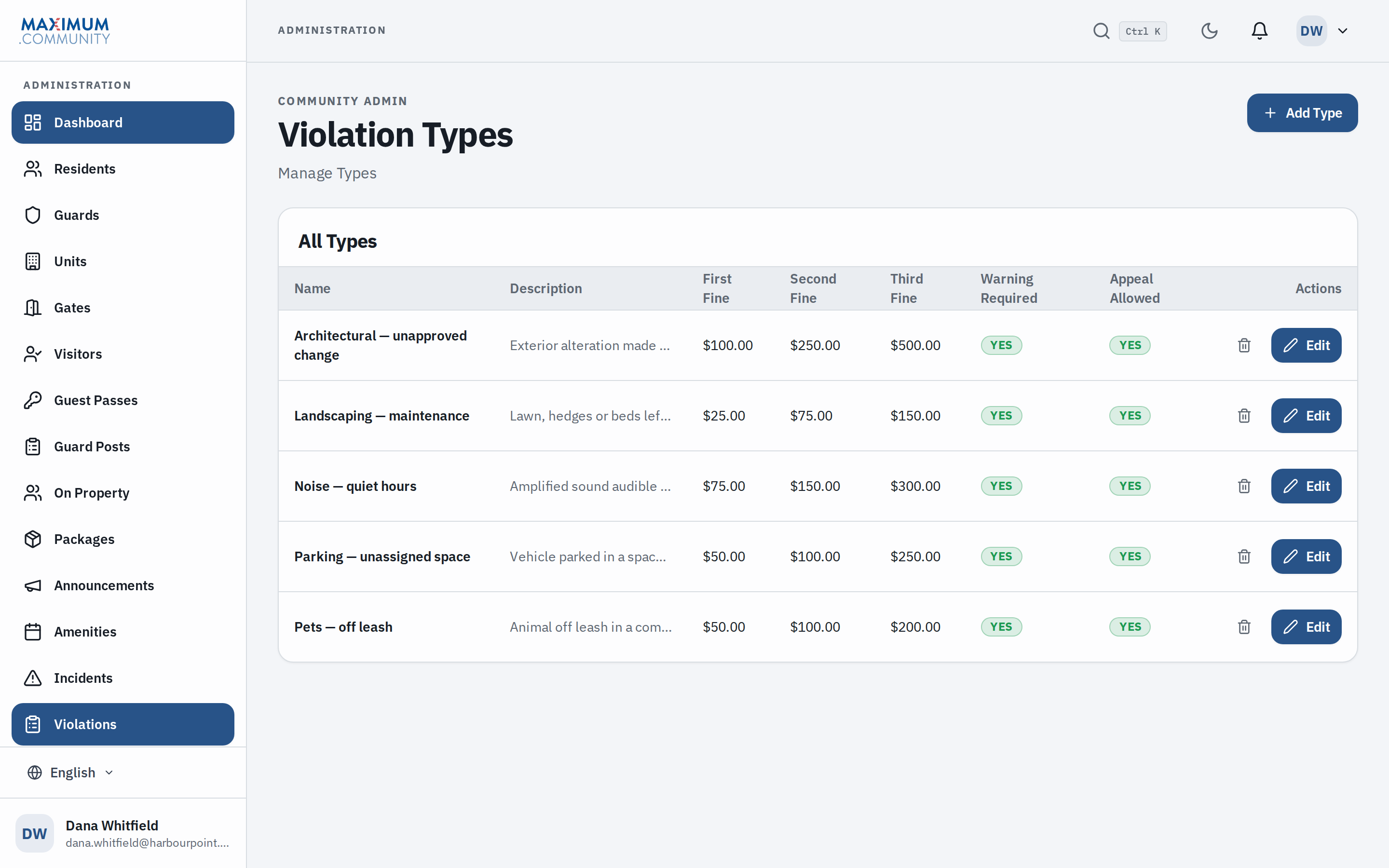
Four of the records a board ends up needing: what was reported, who was on the property, what has been enforced, and the schedule the board itself wrote.
The ladder is yours
Each category carries your own first, second and third amounts and a flag for whether a warning has to go out before any of them. The numbers come out of your governing documents. The platform holds them in one place, where every case is measured against the same ladder instead of against whoever happened to take the complaint.
An appeal is part of the shape
Each category also records whether a resident may appeal it. A case that is appealed sits at that stage in the register rather than quietly turning into a fine, so a board can show the warning, the notice and the appeal in the order they happened.
Who your board is dealing with.
Max Security USA is a physical guard company, founded and led by decorated law enforcement veterans with more than 130 years of combined service. We work out of 709 W Jericho Tpke, Huntington NY 11743.
The wider guarding business is at maxsecurityusa.com.
New York
Long Island and the wider metro area, from our office in Huntington.
New Jersey
Gated communities and managed properties across the state.
Florida
Boca Raton, Fort Lauderdale and Miami.
The platform runs anywhere. Guarding, patrol and access control need guards and vehicles within driving distance of your property, so tell us where you are and we’ll tell you whether we can cover it.
FAQ
What boards ask before they put it on an agenda.
If your question isn’t here, ask it on the call. None of this is legal advice, and where an answer depends on your governing documents or state law we say so. Read the privacy policy and the terms, or email [email protected].
Bring the answers to the next meeting.
Fifteen minutes on the phone tells you what your community would get and what it would cost. If it isn’t a fit, you’ll hear that on the same call.