Max Security USA · Quoted per site
A patrol car on your roads, sent where it is needed.
Marked cars and roving guards working your community overnight. Gates and clubhouse doors checked by hand, and when a camera flags something, a guard goes to look that night instead of someone reviewing the recording the next morning.
- Licensed, insured guards
- Marked vehicles
- Free resident platform included
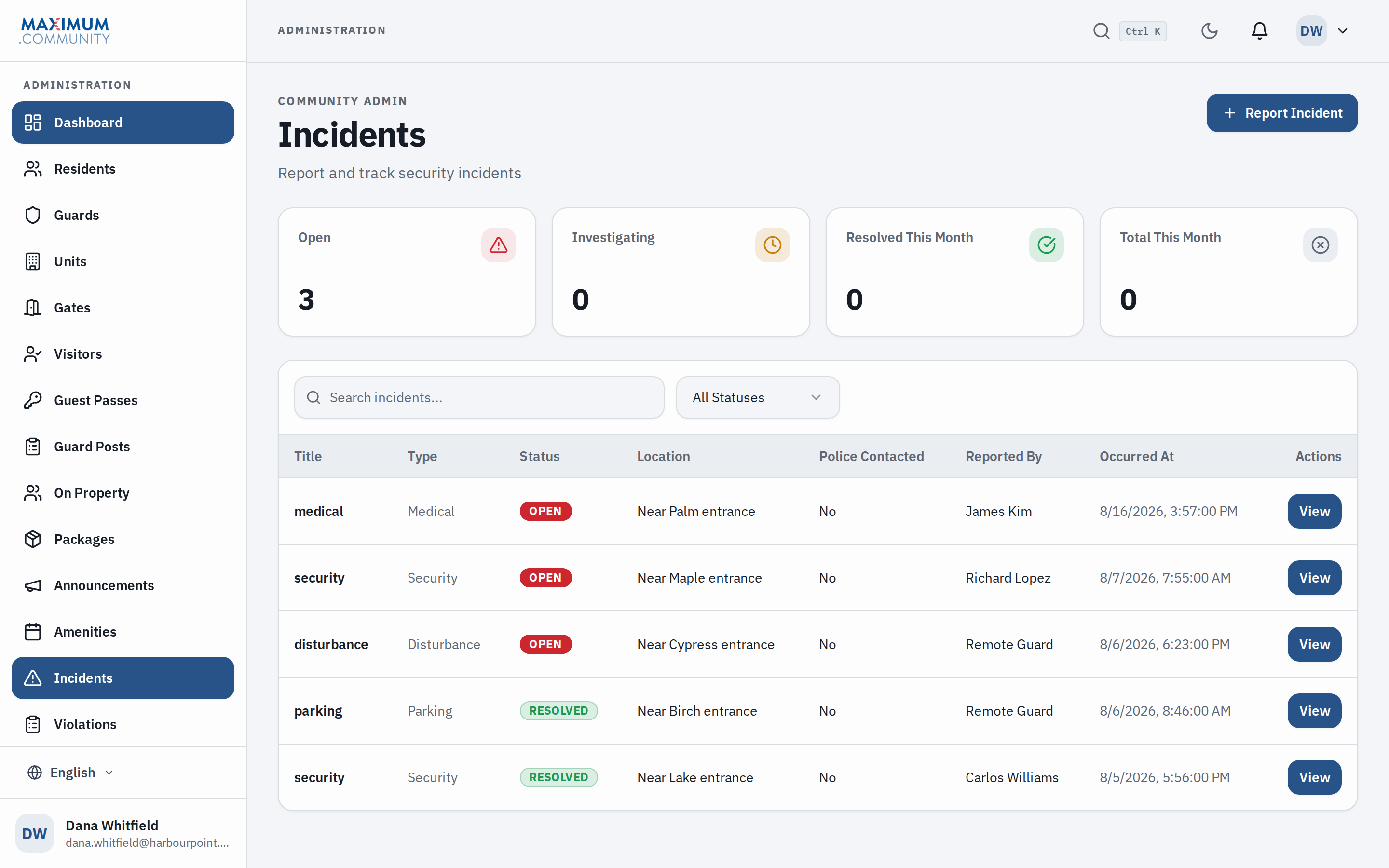
The difference from a standalone patrol contract is what the guard is connected to. A camera flags movement or a plate matches the deny list, and the car that is already on the property is sent to that spot, for that reason.
See how it connects to the camerasWhat a patrol consists of
What the guard does on a round.
Every patrol company tells a board its guards are a deterrent. What matters is what they do between the gate and the far end of the property. This is our list.
Being seen
A marked car at hours nobody can predict does most of its work before anything happens. Someone trying car doors on a cul-de-sac, or a crowd at the pool after closing, does not stay put once headlights round the corner.
Working the perimeter and the back gates
The guard drives the fence line and gets out at the side gates and service entrances, the places nobody else looks at. That is where the gate a contractor propped open at two in the afternoon gets found.
Checking amenities and common areas
The clubhouse, gym, pool, mail room and decks are walked and the doors tried by hand. The guard confirms the lights are on and the cameras are up. If someone is in the gym at midnight, it is dealt with in person rather than noted for the morning.
Reporting the things that are not crimes
A lamp out on the entry road. A gate arm hanging by one bolt. An irrigation line that has been running since dusk. The guard sees these before residents do and logs them in the same place as everything else.
Vehicles and parking
A car that has lived in guest parking for a month, a van in the fire lane or a handicapped bay, a plate nobody recognizes. Each one is checked against the same records your gate and cameras run on.
Responding
When a resident, a gate guard or a camera flags something, the guard goes. What can be settled on the spot is settled. What needs the police gets the police. Either way it is written up with the photos or footage attached.
Where a standalone patrol contract stops
A camera flags it. A guard is already on the property.
A patrol firm with no cameras sees whatever it happens to drive past. A camera company with no guards sends an alert to someone who then has to decide, at 3am, whether to call the police. We run both, so the alert goes to a car that is already inside the gate.
Step 1: Something is seen
A camera catches movement at the pool at two in the morning. A plate at the gate matches the deny list. A resident reports something. Each of these is already a defined event in the system.
Step 2: Somebody with the context sees it
The monitoring center is staffed around the clock and watches the guard booths and the cameras. The alert lands there with the plate, the pass behind it, the resident who issued that pass and the camera view, so the person looking at it has the file open.
Step 3: A guard is already on the property
The car is already inside the gates, so there is no call-out and no drive across the county. The guard is sent to a particular building for a particular reason. A standalone patrol contract cannot do this, and neither can a camera company on its own.
Step 4: It ends up in one record
It is logged as an incident with the footage attached, in the same record as the gate log, the visitor passes and the violation history. When the board asks about it three weeks later there is one account to read instead of three memories to reconcile.
It runs the other way too
What the guard finds on a round goes back into the system, so it is still there when the shift ends and the next one starts.
- A car that has no business on the property goes on the deny list, and where the gate camera reads plates, the guard’s screen flags it the next time it turns in.
- A vendor still on site after the window on their pass is checked against the pass the resident issued.
- A parking violation is recorded against the plate registered to that unit instead of on a pad in the glovebox.
- A hanging gate arm becomes a work order that management can see and assign in the morning, rather than something remembered at the next board meeting.
What a patrol cannot do
We would rather say this before you sign than have you find it out afterwards. A patrol has limits, and a company that claims otherwise is selling something it cannot deliver.
- A security guard is not a police officer. The job is to observe, report, deter, hold a scene and call it in. You are not buying arrests.
- One car cannot be at the north gate and the pool at the same time. Cover is a question of hours and route, and we will tell you where the gaps are.
- A patrol does not replace a staffed gate. It covers the property behind the gate; it does not decide who comes through it.
- Nothing prevents everything. A marked car that shows up when it is not expected sends most trouble somewhere else and cuts the rest short.
The honest comparison
Us versus a standalone patrol contract.
We have not audited anyone else’s product, so the comparison is with a standalone patrol contract from a firm that does nothing else on the property. That is the choice a board is actually making.
| At the gate | Patrol on the platform | A standalone patrol contract |
|---|---|---|
| Why the car is where it is | Sent to a specific place for a reason | Sees whatever it happens to drive past |
| Getting there | A guard is already on the property | A call-out, and a drive across the county |
| A plate nobody recognizes | Checked against the same data your gate and cameras use | Scribbled on a pad |
| What the guard finds | Goes back into the record the board reads | Gone when the shift ends |
| Proof the patrol happened | Incidents logged as they happen, with footage attached | A PDF that arrives a month late |
Scroll the table sideways to compare →
How cover is set
Cover is built around the property.
We don’t publish a number of rounds per night. It depends on how big the property is, how many ways in there are, and what the board is prepared to fund.
Overnight cover
Often the cheapest addition that earns its keep. A car works the property while the booth is closed or quiet, then hands over to the morning shift in writing.
Dedicated or shared
A car assigned to your property for a block of hours, or scheduled visits from a car on a shared route. The dedicated car stays the whole time and costs more. The shared route costs less.
Varied timing, deliberately
A car that comes through at the same hour every night teaches anyone watching when to be somewhere else. So the timing moves. Checks that have to happen at a set time, the pool gate at closing for one, are written into the post orders.
Written post orders
What the guard checks, what to do about each thing found, and who gets the call at 3am. Your board agrees the orders, every guard on the route reads them, and each one signs off that they have.
Accountability
Proof the patrol happened.
A board paying for a patrol should be able to see whether the car came, what it found and what was done about it. All of that goes into the same platform the community already uses for visitors and violations.
Incidents, logged as they happen
Written up with the photos or footage attached, next to the gate log and the visitor record. It can be exported if you need it as evidence.
Post orders and shift notes
The standing orders for the property, which each guard acknowledges in our iPhone and Android guard app, now in testing, and the handover notes that pass from one shift to the next.
Reports for the board
Entries, refusals, violations and incidents, pulled from the record for the meeting rather than typed up from memory the night before.
The platform, either way
$0
Visitor management is free for any community, with no subscription and no per-resident fee, whether you buy patrol from us, buy nothing, or keep the guard company you have. It is not a trial and it does not depend on anything else on this page.
What patrol costs, and how we get there
Quoted per site, after a survey
The price follows the hours covered, the size of the property, how many entrances it has, and whether the car is dedicated or shared. We walk the site before we put a number on paper, so the number does not change later.
Separate from the free platform
Patrol, guarding, cameras and access control are Max Security USA services, quoted per site. On the platform itself only three things cost money: text messaging, access-control integration (the hardware plus a licensed installer, quoted per site), and white-labeling.
No sign-up button, deliberately
Every community is vetted and set up by a person on our side. A platform that hands out gate access ought to know who it is handing it to.
Where the cars are.
Max Security USA is led by decorated law enforcement veterans with 130+ years of combined service, and works out of 709 W Jericho Tpke, Huntington NY 11743. Distance matters more for patrol than for anything else we do, so the first thing we will ask is where the property is.
New York
Long Island and the wider metro area, from our office in Huntington.
New Jersey
Gated communities and managed properties across the state.
Florida
Boca Raton, Fort Lauderdale and Miami.
Georgia, Arizona and Maryland
Tell us the address and we will tell you what patrol can reach it, including around Baltimore.
FAQ
What boards ask before they sign a patrol contract.
Where the honest answer depends on the property, we say how it is decided rather than invent a number. If your question is not here, ask it. We’d rather answer it before the survey than after the contract.
How often do patrols run, and how many times a night will you come through?
That is set per community, and we don’t publish a number, because a number on a web page would mean nothing for your property. You choose a dedicated car or scheduled visits on a shared route. The timing is varied on purpose, and the checks that have to happen at a set time, like the pool gate at closing, are written into the post orders.
What does a guard actually do on a patrol?
Drives the roads where the car can be seen. Walks the fence line and the side gates nobody else looks at. Tries the clubhouse and pool doors, and deals with whoever is in the gym after hours. Checks parked cars against your records, answers calls, and logs everything found, down to the lamp that was out at 3am.
Are your guards licensed and insured?
Yes. Every guard is licensed in the state they work in, and Max Security USA carries commercial insurance. You get a certificate naming your association before the first shift, and you should ask for both on the first call. Armed or unarmed is a separate decision for the board; it changes the licensing and the price.
Can we see a report of what happened?
Yes, and you don’t wait a month for a PDF. Incidents go into the platform as they happen, with the footage attached, in the same record as the gate log, the visitor passes and the violation history. A board member with access can open it at 9pm the night before the meeting, and the reporting section pulls the numbers the meeting will ask for.
What areas do you cover?
New York, including Long Island, from our office at 709 W Jericho Tpke, Huntington NY 11743. New Jersey. And Florida, meaning Boca Raton, Fort Lauderdale and Miami. Distance matters more for patrol than for any other service we offer. If you are outside those areas, tell us where you are and we will say plainly whether we can cover you.
How quickly can you start?
It starts with a survey, and we don’t sit on those. After that it depends on the hours you want and where the property is. An area we already work is faster than a new one. We’ll give you a real start date on the call.
What does vehicle patrol cost, and are we tied into a long contract?
It is quoted per site after the survey. The price follows the hours, the size of the property, the number of entrances, and whether the car is dedicated or shared. Contract terms are agreed with your board. Patrol is a separate purchase from the visitor management platform, which is free.
Do we have to buy patrol to use the free visitor management platform?
No. The platform is free for any community, with no subscription, no per-resident fee and no trial that quietly ends. Only three things on the platform cost money: text messages, access-control integration (hardware plus installer, quoted per site), and white-labeling. Guarding, patrol, cameras and access control are Max Security USA services, quoted per site.
What happens to the footage and the patrol records, and who owns them?
The community owns its records, its footage and its incident history. We hold them to run the service, we never sell them, and we hand them back if you leave. Guards work the roads and common areas, never inside anyone’s home. The rules on audio recording are stricter than the rules on video and vary by state, so they are agreed with your board in writing.
If the cameras or the internet go down, does the patrol stop working?
No. That is the practical case for having a person on the property and not only cameras. The guard keeps checking gates, doors, amenities and roads whether or not the network is up, and writes it on paper until it comes back. The camera link makes the patrol better aimed; the guard is what makes it work.
Read the privacy policy, see the rest of the lineup at maxsecurityusa.com, or email [email protected].
Tell us about the property.
We’ll walk it, tell you where it’s exposed, and quote the hours that will make a difference rather than the biggest invoice we could write. If what the property needs first is a lamp fixed and a gate arm replaced, we’ll say so.