Our flagship · Traffic safety & enforcement
Speeding and rolling stops, enforced on the roads your community owns.
Stop-sign and speed violations caught on the cameras your community already has, with the evidence for your board’s own enforcement process. A person reviews every violation before anything is sent. This is the one paid part of Maximum.Community, quoted per site. Visitor management is free.
See how it works — a two-minute walkthrough →
- Runs on your existing cameras
- A person reviews every clip
- Warnings only, for as long as you want
The problem boards keep bringing us
On a private road the rules are yours, and nobody enforces them.
The police do not patrol a road the town does not own. A guard cannot stand at the stop sign all day. So the complaint about the same car at the same corner every morning lands with the board, and the board has nothing it can act on. What it needs is a record: who, where, how fast, and how often, proven well enough to hold up and applied the same way to everyone.
The honest comparison
Against the sign you already have.
We are not comparing ourselves with another vendor. The right-hand column is what a private road has today.
| At the gate | Maximum.Community | A sign and a complaint |
|---|---|---|
| Who enforces the limit | Your association, on the roads it owns | Police do not patrol a road the town does not own |
| Watching the stop sign | Runs day and night on the cameras you already have | A guard cannot stand at the stop sign all day |
| What the board can act on | A record of who, where, how fast and how often | A complaint, and no way to act on it |
| What sits behind a notice | The clip, the plate image, the measurement, the location and the rule | Somebody’s recollection, applied differently to different people |
Scroll the table sideways to compare →
How it works
Three steps from a rolling stop to a notice.
Usually no new hardware. It runs on the cameras you already have, and a person signs off before anyone hears from us.
Step 1: Your cameras, our AI
The software reads the plate and measures what the car did: how far it rolled through the stop line, or how fast it went on the stretch you asked us to watch. It runs day and night.
Step 2: A person confirms it
Nothing goes out on the machine’s say-so. Each candidate lands in a review queue with its clip and plate image, and a reviewer confirms it or throws it out before any resident hears about it.
Step 3: The resident gets the proof
The registered owner receives a notice with the evidence on it: the clip, the plate photo, where, when, and which rule. One tap to view it, pay it if fines apply, or dispute it.
Why a person looks at every clip
Detection software is good. It is not perfect. It can read an 8 as a B, or flag a car that stopped to let a pedestrian cross. The software narrows thousands of passes to the handful worth a look, and a person makes the call on each one.
What a resident receives
The notice carries its own evidence.
By email, by posted letter or by QR code, whichever your community uses. The same six things are on it either way.
The clip
The video the finding came from.
The plate image
A still of the plate, next to the characters the system read.
The measurement
The speed recorded, or what the car did at the stop line.
Location and time
Which camera, which junction, and the exact time.
The rule broken
Which community rule it was, in your board’s own wording.
How to respond
One link to view it, pay it if fines apply, or dispute it.
Built to be fair
Enforcement your board can stand behind.
The quickest way to lose a community’s trust is a fine that looks arbitrary, or a neighbour who never seems to get one. This applies your rule to every car the same way. Nobody gets a quiet pass.
Evidence on every notice. The photo, the clip, the plate and the time go out with it. Nobody has to take our word for anything.
Warnings before fines. Add fine tiers only after your community has seen for itself that the reads are accurate.
Residents can appeal. A person reads every dispute, and the reason for the decision is written down.
You set the thresholds. Speed, rolled stops and enforced hours are your board’s call, and the rule is applied the same way to every car.
What you need
Usually the cameras you already own.
If the cameras at your gate and along your roads can read a plate at the spot you care about, they can do this job.
What makes a camera usable
A clear view of the plate, a shallow angle, and enough light at night. The camera over the lobby door will not do it. We check every camera at the assessment.
What we add
Where there is a real blind spot, we quote the hardware and the installation through Max Security USA. That is a real cost, priced per site, and it is never folded into a monthly figure.
What we tell you before you sign
If your cameras cannot support enforcement at a junction, we say so at the assessment, not after the contract. A bad plate read produces nothing but disputes.
The awkward questions
Who has the authority, and who owns the footage.
Where the authority comes from
On roads the association owns, a notice is an association matter under your governing documents. It is not a municipal traffic ticket, and it carries no license points and no DMV record. Most states require written notice and a chance to be heard before a fine is charged, and our review and appeal path is built to fit that. Your association’s counsel should sign off before you move from warnings to charges.
Who the footage belongs to
The cameras cover the roadway, not gardens or windows, and they identify a vehicle by its plate rather than by a face. The records belong to your association.
- Roadway only, read by plate and not by face.
- Recorder retention set by your board.
- Every access to the footage logged.
- Never sold or used for advertising.
- Exported for the board on request, and yours if you leave.
What it costs
Quoted per site, after we have walked your roads.
There is no price list. A two-junction community and a twelve-junction one are different jobs, and the cost depends on how many locations, cameras and notices are involved. We assess the site, then send a written quote, and then your board decides. If cameras or installation are needed, Max Security USA quotes those separately. We will not tell you it pays for itself out of fines.
Worth knowing before you ask
Traffic enforcement is the paid product.
Somebody has to review the clips, host the footage and deliver the notices. That ongoing work is why it is not free.
Visitor management is free.
The whole platform is free for any community. That includes work orders, amenity booking and board reports.
Cameras and installation are separate.
Max Security USA quotes them per site. They never turn up as a hidden monthly figure.
No self-service sign-up.
A person verifies every community and sets it up.
Getting started
Nothing is enforced until your board has agreed it.
Your meeting calendar sets the pace. Warnings can start within a few weeks of the board agreeing thresholds.
Step 1: Site assessment
We walk your roads and look at your cameras: which junctions matter, which roads are yours, and where a camera can actually read a plate.
Step 2: Your board sets the rules
Thresholds, enforced hours, warnings-only or fines, and the wording on the notice. Nothing is configured until the board has agreed it.
Step 3: Warnings first
Courtesy notices go out with the full evidence, so residents meet the system before any money is attached.
Step 4: Fines only if you choose
We change the setting on your instruction. The appeal path stays exactly as it was.
About an hour on site. You get the findings whether or not you go ahead.
Where we work
New York, New Jersey and South Florida.
Max Security USA is led by decorated law enforcement veterans. The same company that guards gates and patrols properties runs the traffic enforcement, so when a camera flags something there is a person behind it. We cover Long Island, the wider New York area, New Jersey and South Florida.
709 W Jericho Tpke
Huntington, NY 11743
Guarding, patrol, cameras and access control are Max Security USA services, quoted per site.
FAQ
What boards ask before they say yes.
The awkward ones are in there. If yours is not, ask it on the form below and you will get a straight answer.
Book a 15-minute call.
Tell us where your gate is. We call you back, talk through the entrances and who staffs them, and tell you on that call whether your cameras are up to it. Visitor management is free for your community.
Rather talk now?
Call us on (631) 673-3643How enforcement works
AI finds it. A person decides it. The board owns it.
No notice reaches a resident because a computer decided it should.
AI watches the cameras you already have
Software reviews the footage from your existing cameras and flags vehicles that appear to have rolled a stop sign or exceeded the limit the board set. Nothing new gets mounted on your poles for this to start.
A person checks the clip before anyone hears about it
Every flag is reviewed by a human being, who watches the video and reads the plate, before a single word reaches a resident. If the clip does not clearly show what the software thought it showed, it is dropped there and the resident never knows it existed.
The board sets the thresholds
What counts as speeding on your roads, what counts as a rolled stop, how many warnings come before anything else — those are the association’s decisions, recorded and changeable. We do not set them and we do not have an opinion about them.
Warning first, evidence attached, one tap to dispute
The first contact is a warning, not a penalty. It carries the video that prompted it, and a single link to dispute it. Disputes go to the board, which has the final say — we are not the judge of your community’s rules.
Things we will not do
Take a share of your fines
We are not paid more when your community penalises more. A vendor whose revenue rises with your violation count has an interest opposed to your residents’, and no promise of restraint survives that.
Lock a resident out of their own gate
An unpaid fine is a dispute between a resident and their association. It is never a reason to deny somebody entry to their home, and the platform will not do it.
Feed your plates to a national network
Reads stay with your association. We do not pool them into a national ALPR network, sell them, or hand them to law enforcement outside a valid legal request. Your data is yours, and it leaves with you.
In Florida, Chapter 720 limits a homeowners’ association fine to $100 per violation unless the governing documents provide otherwise, and a fine cannot be imposed until the resident has had the chance to be heard by an independent committee of members who are not officers, directors, or their relatives. The platform is built around that sequence — warning, evidence, hearing — and your association attorney reads your governing documents, not us.
The record
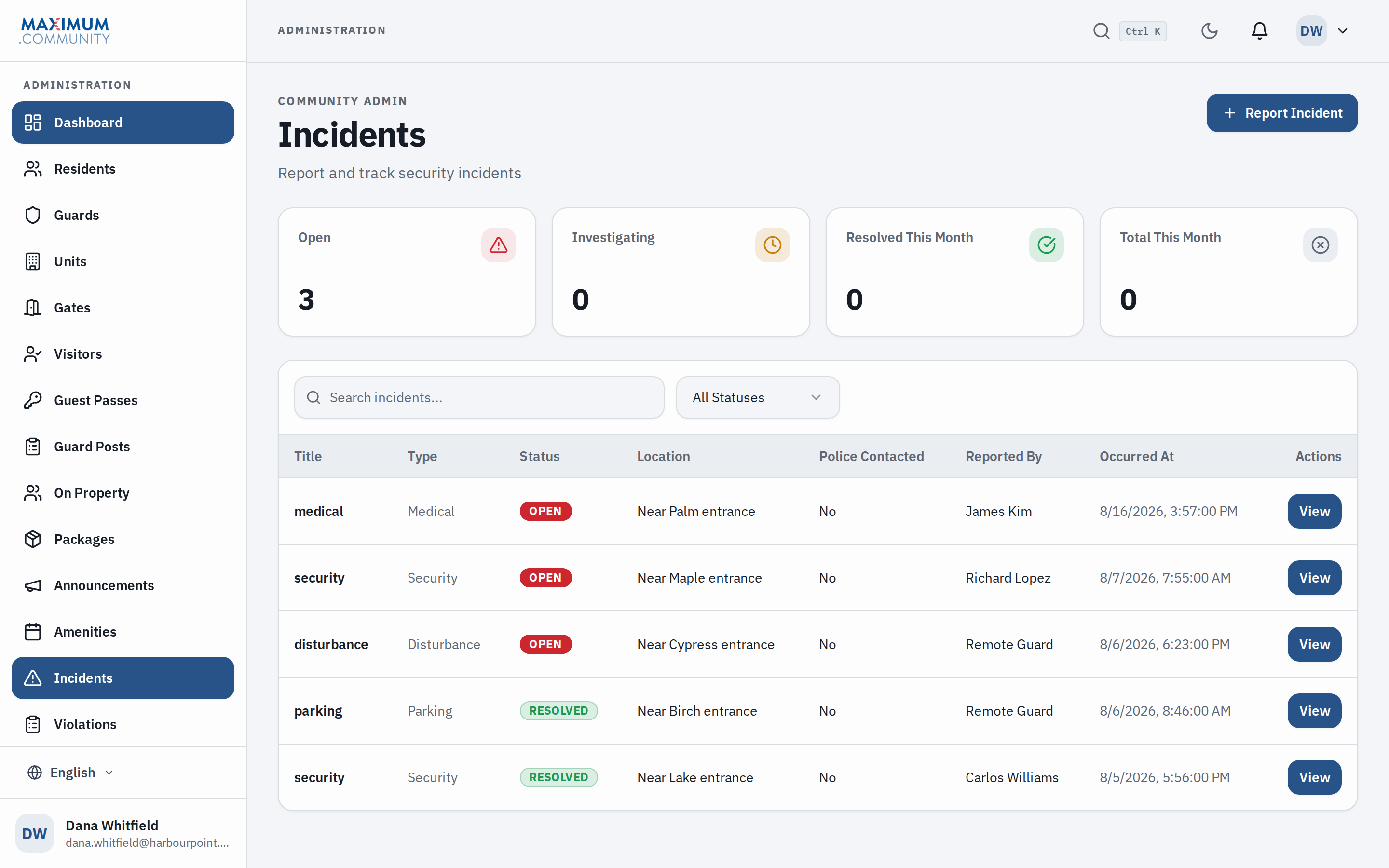
Every event, with its evidence.
Book the site assessment.
We walk your roads, send a written quote, and your board decides. Nothing is enforced until the board has agreed it.