Max Security USA · 24/7
Remote gate guarding, with a licensed security guard on watch around the clock.
A Max Security USA licensed security guard works your gate or lobby from our monitoring center. They answer the intercom, check the pass against your community’s live records, open or refuse, and watch the entrance between arrivals. The software does the looking up. The guard does the judging.
New to this? What a remote gate guard is, in plain terms
- A licensed security guard on the intercom
- Quoted per site
- Free resident platform included
It suits a community whose gate needs covering overnight, or whose booth sits empty because the shift cannot be filled. It also suits the back entrance nobody watches at all.
Security company? See the partner programSee it at an HOA.
A short film from Max Security USA, who staff the monitoring center.
What the shift consists of
What the guard does on your gate.
Here is what a virtual guard service looks like from the guard’s chair, in the order the work comes in.
Step 1: Answering the gate
The intercom rings and a guard picks up. They see the driver on camera and talk to them. Routine arrivals are settled in that exchange. A van with no pass and a vague story gets the questions a good guard asks when something does not add up.
Step 2: Verifying against the list
The guard checks the name and plate against the community’s live records: the pass, the vendor’s window and the watchlist, which shows the reason for any match. The answer is allow or refuse before the gate arm moves.
Step 3: Watching the entrance between arrivals
Between calls the guard’s screen shows your cameras. A car tailgating through the gate, a vehicle idling by the arm, someone on foot slipping in behind a resident. The guard sees it while it is happening, rather than somebody finding it on a recording the next morning.
Step 4: Talking to people on site
Where the entrance has a speaker, the guard can address someone at the gate directly. Being called by name and told you are on camera ends a lot of situations on the spot.
Step 5: Escalating properly
A remote guard cannot step out of a booth, so escalation is agreed with you in advance and written down. Which patrol car comes, when the property manager is woken, when the police are called, and who takes the call at two in the morning.
Step 6: Leaving a record
Every entry, refusal and incident goes in the log with the time and the guard’s name, and the shift is handed over in writing. When a board member asks what happened on Tuesday night, there is a record to read instead of somebody’s memory.
Where the software stops
The software looks things up. The guard decides.
The software takes over the looking-up, the typing and the staring at an empty driveway, so the person on watch can spend their attention on the things that need a person. The person stays.
The software handles
- Takes plate reads from gate cameras that read the plate, and matches each one against residents’ cars, active guest and vendor passes and the deny list.
- Flags motion on a camera that should be showing an empty driveway.
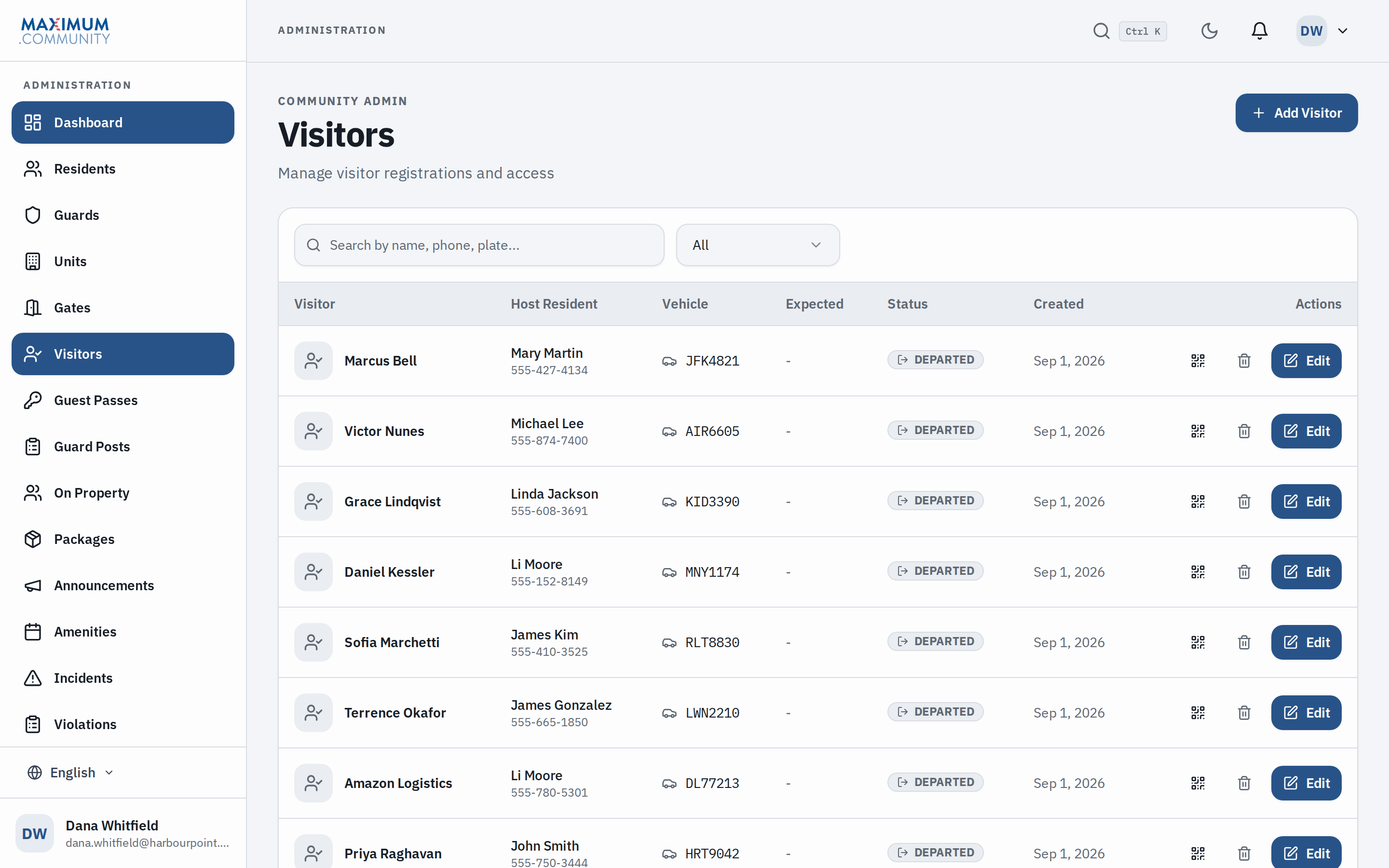
- Puts the visitor’s pass and its conditions on the guard’s screen while the intercom is still ringing.
- Lets Guardina, our AI intercom, take the routine pre-registered arrivals so the guard is free for the ones that are not.
The guard decides
- Deciding whether a driver’s story holds up. That is the job at a gate, and we do not hand it to software.
- Refusing entry to someone who is angry about it, and staying civil while they shout.
- Judging whether what the camera shows needs a patrol car, a phone call, or nothing.
- Anything with a child in it, a medical situation, two neighbours arguing, or a frightened resident.
A remote guard cannot get out of a chair and walk to the gate. Presence on the ground comes from vehicle patrol or an on-site guard, and we usually pair the two rather than swap one for the other.
Compared with a camera
A camera records. A guard answers.
The comparison that matters first is with a camera that only records, which is what a gate has when it does not have a guard.
| At the gate | A remote guard | A camera that only records |
|---|---|---|
| Answering the intercom | A guard picks up, sees the visitor on camera, and talks to them | The visitor is recorded waiting |
| Checking the pass | Name and plate checked against live records: pass, vendor window, deny list | Nothing is checked |
| Between arrivals | Tailgating and idling vehicles seen while they happen | Found on a recording afterward, if anyone looks |
| When something is wrong | A written escalation plan, agreed with you beforehand, runs | Somebody finds it the next morning |
| The record afterwards | Every entry, refusal and incident logged with the time and the guard | Footage, if somebody goes looking for it |
Scroll the table sideways to compare →
Comparing remote guarding companies instead? How we compare with Envera, with every Envera detail quoted from its own site.
How the watch is supervised
We watch our own booths too.
Every guard booth we operate is on camera around the clock, inside and out, and it is watched from the same center that works the remote gates. We started doing this for our own guards. It is still the most useful thing we do for a board.
It changes two conversations. Whether the overnight guard was actually on watch, and who is looking after a guard sitting alone in a booth at four in the morning.
It is also why “nobody is available to respond” does not describe how this works. The center is staffed continuously. That is the same reason it can hold a remote gate at three in the morning.
Interior and exterior
A camera inside the booth and one on the entrance, watched together.
Around the clock
Watched from the same continuously staffed center that works remote gates and lobbies.
The footage settles it
A dispute about a shift is answered from the recording and the shift log.
Remote, on-site, or both
Four ways to cover an entrance.
We put guards on site as well, so here is how the arrangements divide up in practice.
Remote only
An entrance that is busy by day and dead after ten. A building lobby. A contractor gate, or a second entrance that never justified paying a person to sit at it. It is also the honest answer when a booth shift keeps going unfilled, because a covered gate beats an empty chair.
Remote plus patrol
The guard on the gate sees something and a marked car goes. You get eyes on the entrance the whole night, and a physical presence that moves around the property instead of sitting in one chair until dawn.
On-site, watched remotely
Some properties need a person standing at the barrier and should keep one. The remote layer then supervises. The booth is on camera inside and out, and a second pair of eyes is on the entrance while the guard is dealing with a driver.
Hybrid: on site by day, remote at night
A licensed security guard in the booth for the busy daytime hours, with the center watching alongside, and a remote guard on the gate for the rest. A typical split is eight hours on site and sixteen remote.
How a hybrid schedule works, from the morning handover to the night watch
What it costs.
Remote guarding is quoted per site after a survey. The price depends on the hours covered, how many entrances there are, and what cameras, intercoms and network you already have. The equipment is usually included at no extra charge, and we can offer a 90-day trial. Any per-hour figure printed here would be a number for somebody else’s property.
The visitor management platform the guard works from is free for any community, with no subscription and no per-resident fee. It stays free whether you buy an hour of guarding or never call us again.
Savings estimate
What a hybrid shift would cost
Move the sliders to match your gate. Guard rates vary by market, so put in what you pay today.
Physical guard hours left on the roster: 12 hrs a day. An estimate only — the real figure comes from a site survey.
Estimated annual savings
$43,800
20% less a year, on these inputs
- Today, all physical
- $219,000
- Hybrid
- $175,200
Based on $15/hr remote against $25/hr physical, 365 days. Quoted per site after a survey.
For security companies
The remote guard partner program.
If you run a guard company, your clients are already asking for remote guarding. Building a monitoring center to answer them means premises, redundant connectivity, screens, supervisors, and a rota that still holds at 3am on a holiday. That only pays back across many sites.
So use ours. Max Security USA partners with other security companies to deliver remote gate guarding behind their brand. You sell it, contract it and invoice it, and you keep the account. We provide the center and the guards.
A monitoring center you do not have to build
Premises, redundant lines, supervisors and a rota that holds on Christmas night only pay for themselves across many sites. Use ours. You quote the service and we run the watch behind it.
Your client stays your client
You hold the contract and send the invoice. We do not approach your accounts, and our name does not go in front of them unless you ask for it.
Under your brand
Guards answer in your company’s name and work to your post orders. Full white-labeling, with your branding on the app, the emails and the passes, is bespoke work and is quoted per deployment.
Cover the shifts you cannot fill
Overnights, holidays, a guard who quit on Friday, a site that only needs six hours. Remote cover often keeps a contract you would otherwise have to hand back.
Supervision of your own booths
The same center that watches gates can watch your staffed booths, inside and out. Several of ours already are, which settles the awkward question of what a guard was doing at 4am.
The resident platform, free, in your deal
Visitor management is free for any community, with no subscription and no per-resident fee, and partners put it in front of their clients as part of the offer. There is nothing to license and nothing to mark up.
Yes, we sell this directly too.
Guarding, patrol, cameras and access control are sold direct across New York, New Jersey and Florida, and that overlaps with what is on maxsecurityusa.com. Under the partner program we do not approach the accounts you bring us unless you introduce us. If that is unworkable, say so on the first call. We would rather lose an hour than a relationship.
At the gate
The screen in the booth.
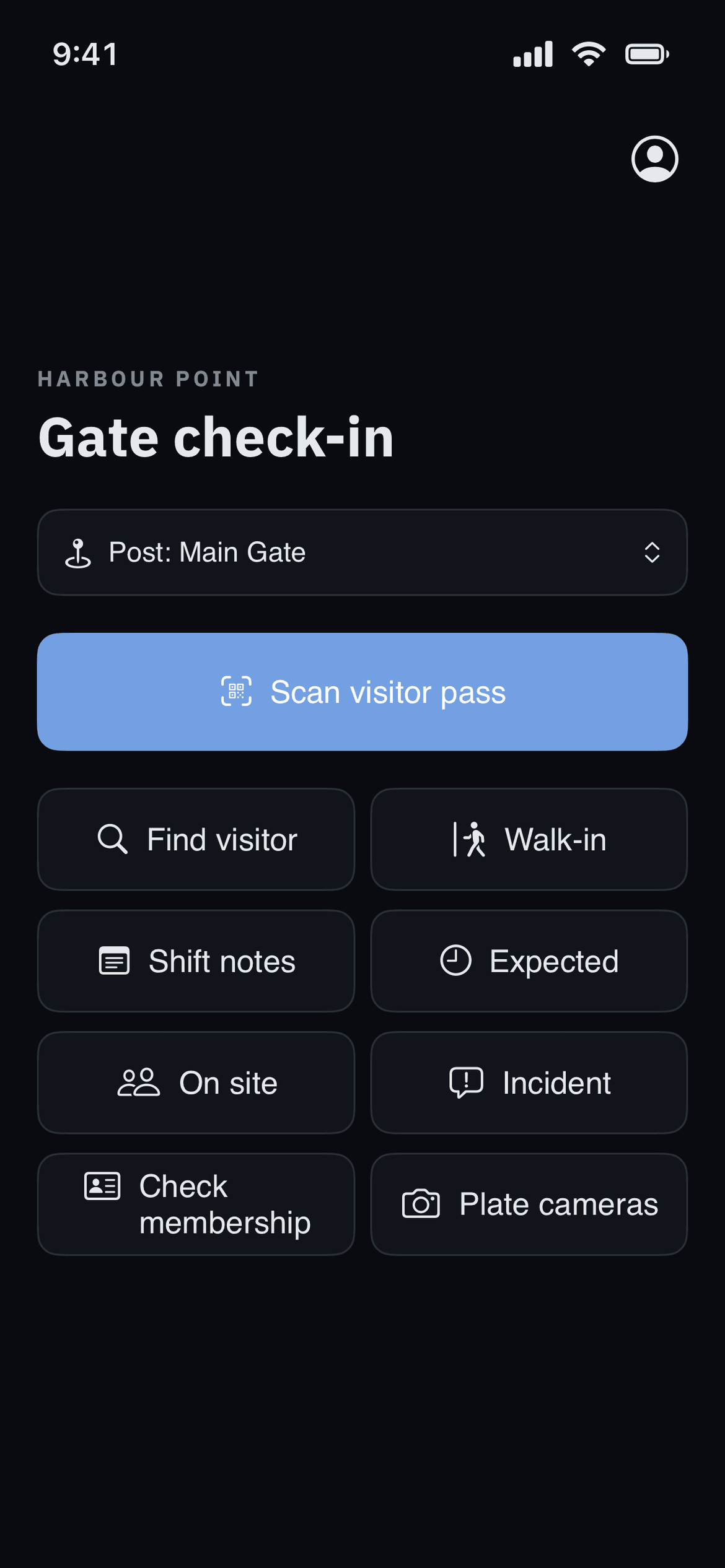
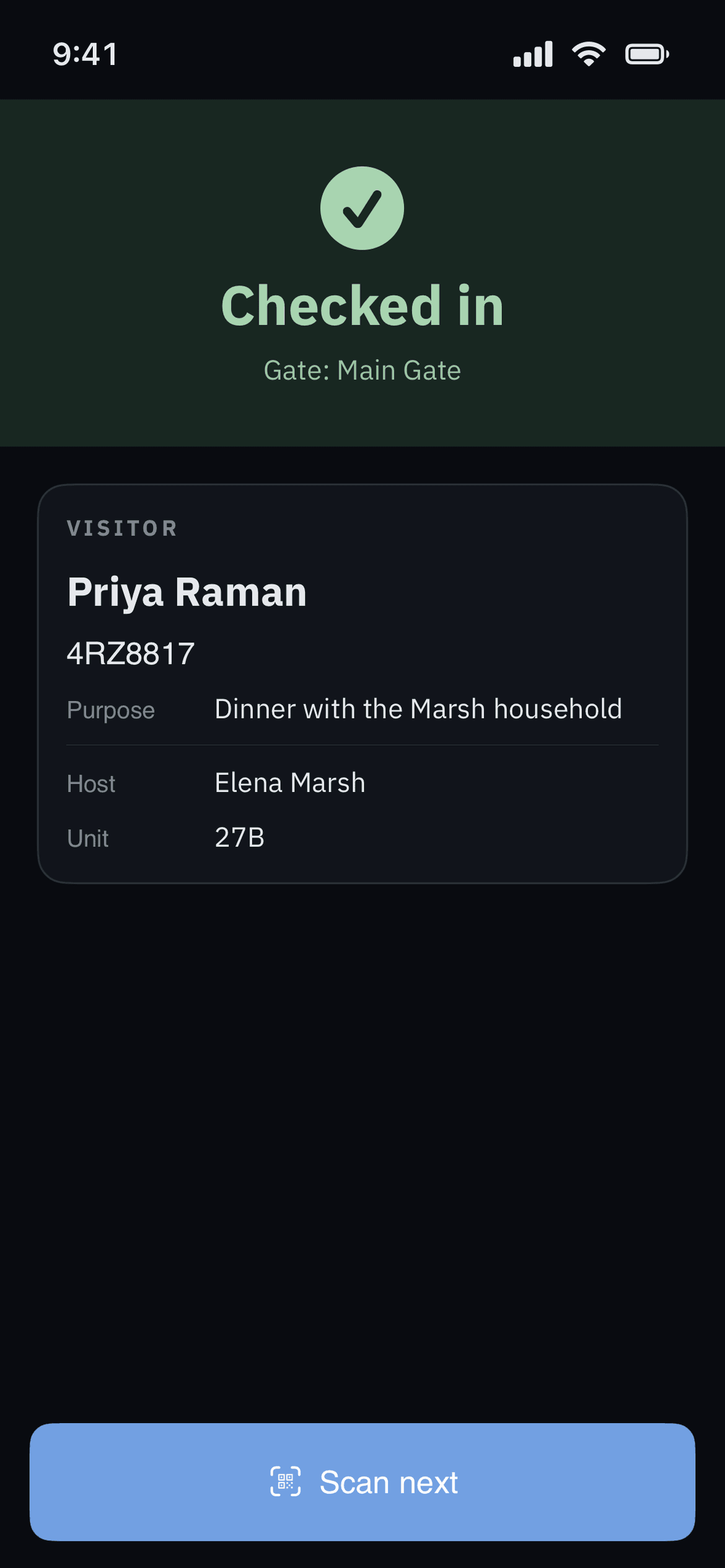
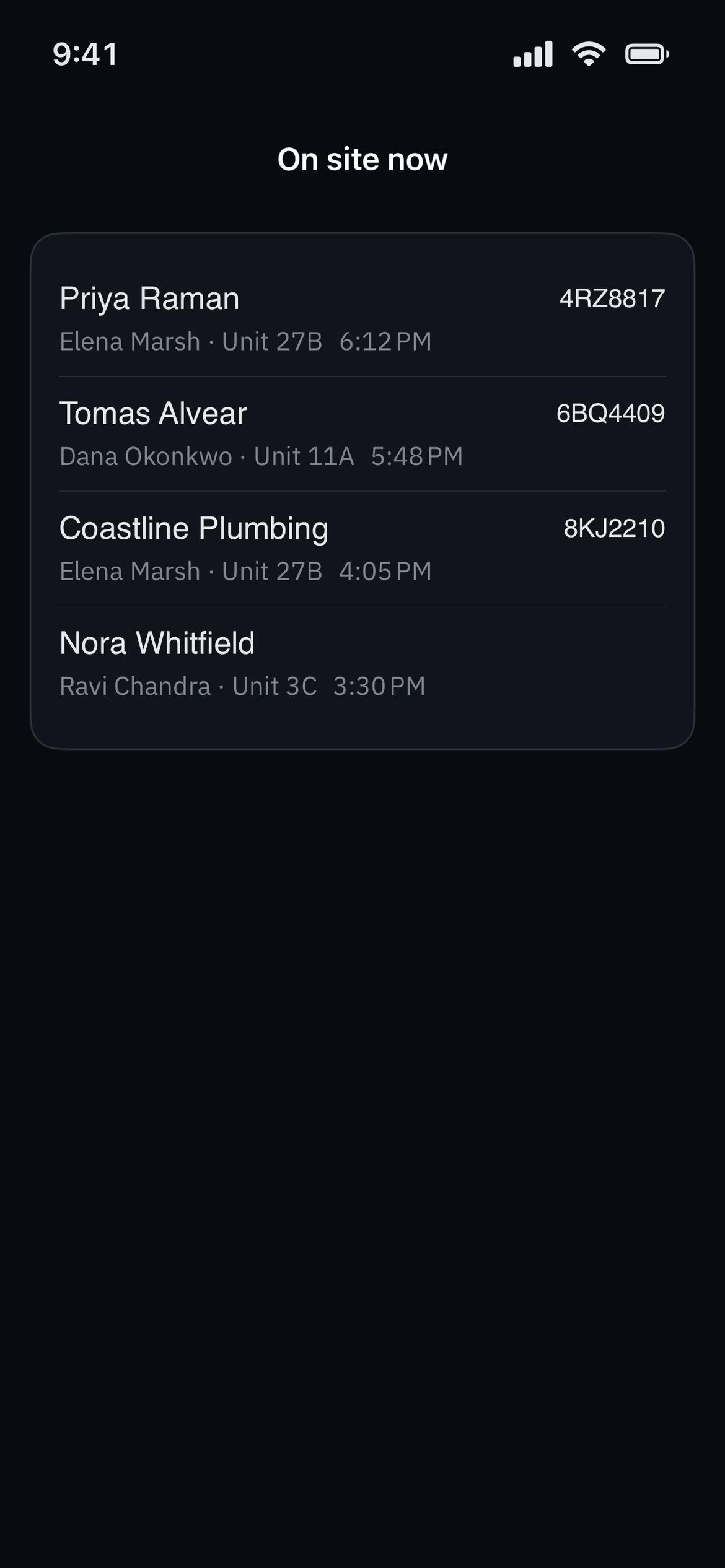
The same record the board reads, on the device in the booth, searchable by name, plate or unit.
Where we work.
Max Security USA is led by decorated law enforcement veterans with more than 130 years of combined service, working from our office at 709 W Jericho Tpke, Huntington NY 11743. A remote watch does not need to be near your gate. A patrol car does, so tell us where the property is.
New York
Long Island and the wider metro area, from our office in Huntington.
New Jersey
Gated communities and managed properties across the state.
Florida
Boca Raton, Fort Lauderdale and Miami.
Georgia, Arizona and Maryland
The same monitoring center works gates here too, including around Baltimore.
FAQ
Questions boards and security firms ask us.
The last two are for security companies rather than communities. Ask us anything else on the call. We would rather answer before a survey than after a contract.
What is remote gate guarding, and how is it different from a camera system?
A Max Security USA licensed security guard works your gate or lobby live from our monitoring center. They answer the intercom, check the pass against your live records, and escalate to patrol or the police under a plan your board agreed to. A camera records what happened. The guard is the service.
Is it a real person, or is it AI?
Both, and the split is fixed. Gate cameras read plates and software matches each read against residents’ cars, passes and the deny list, flags unusual motion, and puts the visitor’s pass on the screen before the guard has finished saying hello. Routine pre-registered arrivals go through Guardina, our AI intercom. Every judgment call is made by a person who is on watch for the whole shift.
What does remote guarding cost?
It is quoted per site after a survey. The price depends on the hours covered, the number of entrances, and what cameras, intercoms and network you already have. The equipment is usually included at no extra charge, and we can offer a 90-day trial. The visitor management platform is free either way.
What happens if the internet or the power drops at the gate?
A remote guard with no connection is no guard at all, so the link is the first thing we survey. The answer can be a cellular failover, a battery, and a written rule for what happens while the link is down. Sometimes the honest answer is that this entrance needs a person standing at it.
Can a remote guard actually stop somebody?
No. Any company that implies otherwise is selling something it cannot deliver. A remote guard sees, speaks, refuses entry and gets the right people moving. The physical presence comes from a patrol car or an on-site guard. Being addressed by name resolves a lot on its own, and when it does not, the escalation plan runs.
Is it legal to record and challenge visitors at our gate, and who owns the footage?
Video at a community entrance is normal practice. Audio is stricter and the rules differ by state, with Florida stricter than New York, so we settle signage, notice and retention with your board in writing. The community owns its records and its footage. Access to them is logged, and we never sell them.
What equipment do we need, and how long does setup take?
Cameras with a usable view of the entrance, an intercom, a gate we can control, and a network connection that holds up. If your cameras point the wrong way we will tell you rather than work around it. The timeline follows the survey. An entrance that already has the equipment is quick. One that needs hardware is a scheduled installation by a licensed installer, quoted per site.
Do we have to buy guarding to use the free visitor management platform?
No. The platform is free for any community: no subscription, no per-resident fee, and no trial that quietly ends, whether you take remote guarding or not. Three things cost money, and each is a real cost: text messages, access control integration (hardware and a licensed installer), and white-labeling. Guarding, patrol, cameras and access control are separate services, quoted per site.
We are a security company. What does the remote guard partner program involve?
You sell remote guarding to your own clients and hold the contract. We provide the monitoring center and the guards, who answer in your company’s name and work to your post orders. It suits a firm whose clients are asking for a virtual guard service, or that has shifts it cannot fill.
You sell the same services directly. Will you compete with us for our clients?
We sell guarding, patrol, cameras and access control directly across New York, New Jersey, Florida, Georgia, Arizona and Maryland, and it would be dishonest to pretend otherwise. Under the partner program we do not approach the accounts you bring us unless you introduce us. If that is unworkable for you, say so on the first call.
Read the privacy policy or email [email protected].
Somebody on your gate tonight.
Communities: tell us about the entrance and we will survey it and quote it. Security companies: ask about the partner program and we will be straight with you about your market.